
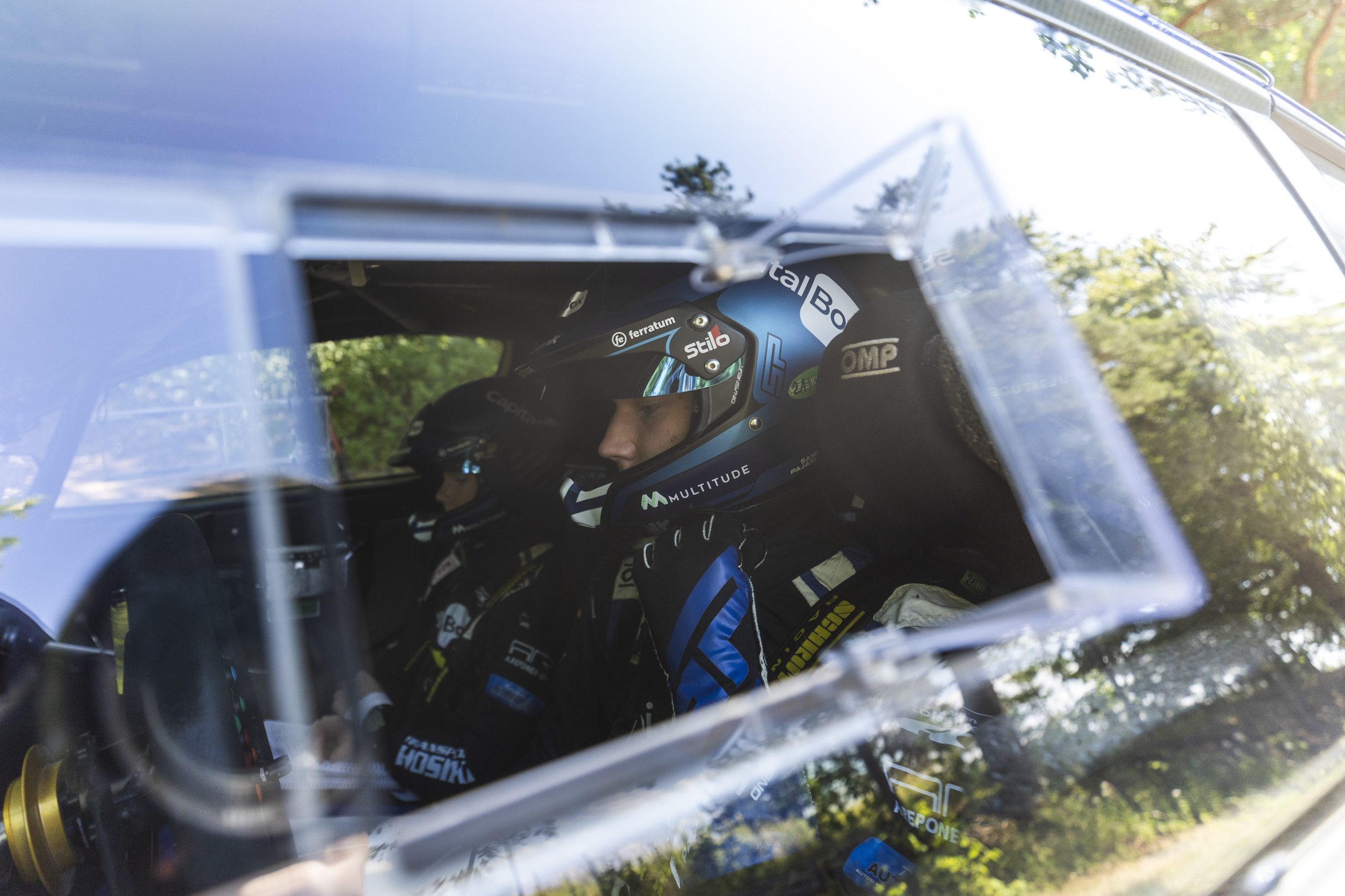
Sami Pajari and Enni Mälkönen’s WRC2 campaign resumes this weekend at the iconic Acropolis Rally in Greece. Their last outing with the Printsport Racing Toyota GR Yaris Rally2 was in mid-July at Rally Latvia. Since then, they reached a career high point at the beginning of August, securing a remarkable fourth place in Finland’s World Rally Championship, driving Toyota GAZOO Racing’s Rally1 car.
In the WRC2 title race, every point now holds immense significance. Among the top contenders in Greece, alongside Pajari and Mälkönen, are Yohan Rossel, Nikolay Gryazin, Jan Solans, Georg Linnamäe, and Lauri Joona, who still holds a theoretical chance of claiming a top-three position.
However, the list of those with a realistic shot at the title is shorter. The leading favourite, Oliver Solberg, will next compete for points in Chile, after which his tally will be complete.
WRC2 drivers can collect championship points from altogether seven events throughout the season, but with their worst finish discarded, only six are counted to the final score. For Rossel and Gryazin, both driving Citroens, their strategy is heavily focused on the season’s final events. Gryazin can still score points in all four remaining rallies, while Rossel can do so in three. However, in the fight for the title, victories are a must for Pajari and his rivals.
The Acropolis Rally, now in its 68th edition, is renowned for its unforgiving conditions. Rocky roads, intense heat, and thick dust pose serious challenges to both cars and drivers. Tactics and careful pace management will play a critical role in the outcome. Nevertheless, Pajari and Mälkönen enter the event with confidence, having performed well in slower gravel rallies earlier this year.
“We were quick in Portugal and Sardinia, so there’s no reason we can’t be competitive here too. The car performed well in those events, and we as a team were fast, so the goal is to race with the rally spirit here as well. I haven’t been thinking about the points situation or putting pressure on myself. The better we do, the better it gets,” Pajari summarised his approach to the event.
There have been a few changes to the route in Greece, with some new stages added for Pajari and Mälkönen to tackle.
“Some stages are the same as before, but there are a couple of new ones, and others have been reversed in direction. We’ll be running with fresh pace notes. Last year, for example, there was a lot of rain before the rally, and the roads tend to change a bit every year as they get graded,” he explained.
Temperatures have also been a talking point, with service park conditions hitting close to 35°C, while at some points along the route, where the altitude reaches 1,500 metres, temperatures drop by about 10 degrees. So, it’s safe to say it will be hot but manageable.
The rally’s central operations remain in Lamia, though unlike previous years, the event will not start in Athens. Instead, the so-called Corinth and Athens loop will take place on Saturday, featuring long liaison sections. The rest of the rally will stay closer to Lamia.
Friday’s stage features six special tests covering a total of 135 km, while Saturday mirrors this with six more stages, this time totalling 116 km. Sunday wraps things up with three stages over 54 km.
“Saturday will be particularly interesting, with only tire service available. It’s going to be a long day, and only one of the stages is repeated. The day ends with a spectator stage, which will be held on a closed section of motorway. It’ll definitely be an intriguing day in many respects,” Pajari remarked.
“Previously, Thursday was the ceremonial start, and there was a lot of travel across Greece, but this year, Thursday is just for the shakedown, which is quite close to the service park. The event feels a bit more condensed this time.”
The first stage kicks off on Friday morning at 7:58 a.m., with a similarly early start on Saturday. On Sunday, the action begins “later,” at 8:59 a.m., with the final stage starting at 1:15 p.m.