
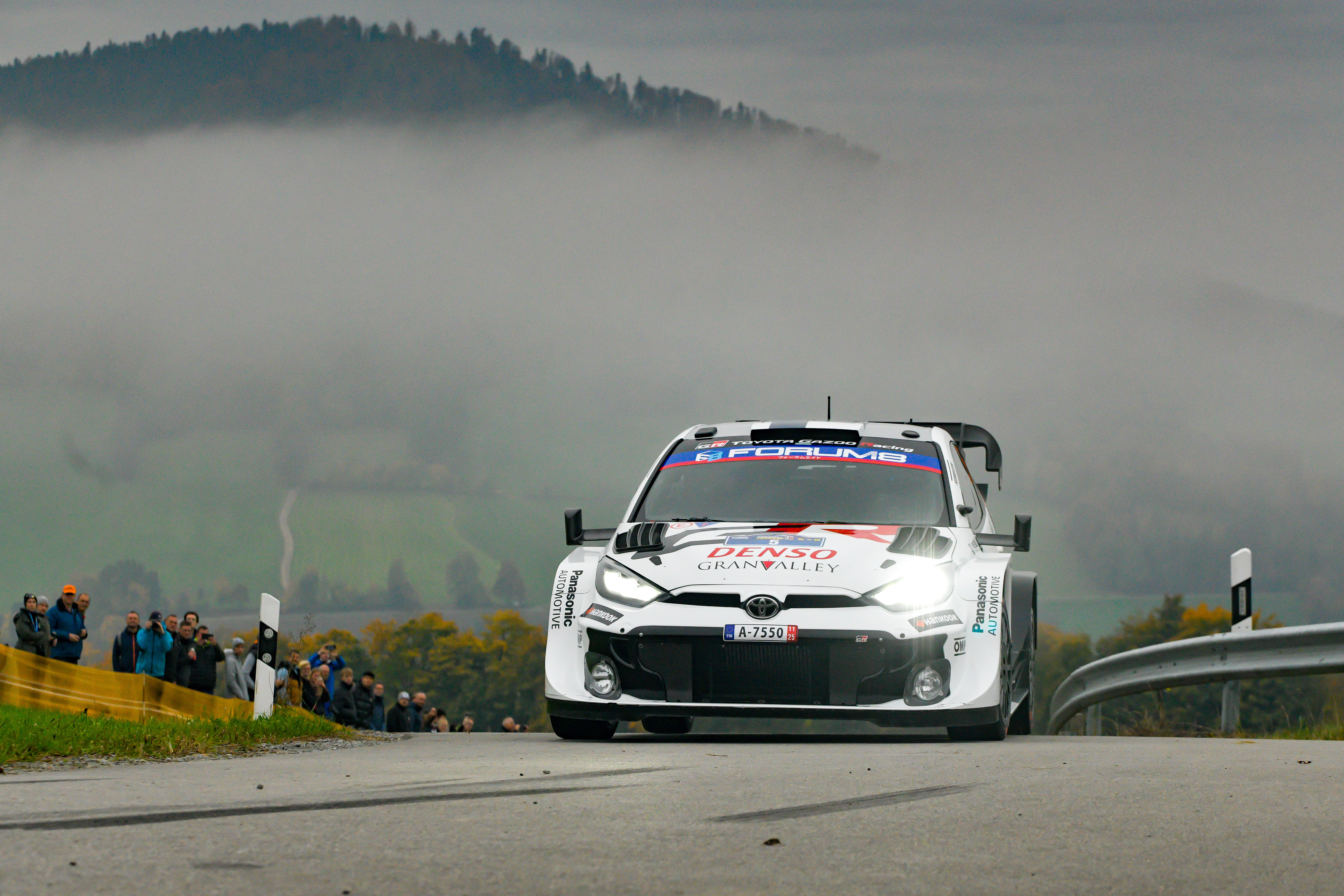
As the 2025 FIA World Rally Championship nears its conclusion, the penultimate round takes the teams to Japan – a rally that is as technically demanding as it is visually striking. Staged in Toyota’s home territory, this year’s edition once again promises its fair share of challenges, with damp patches and fallen leaves lurking on the forest stages to catch out the unwary. For Finland’s Sami Pajari, the event marks another career milestone: his first start in Japan with a Rally1 car.
This 13th round of the season is expected to draw immense attention, with no fewer than four crews still mathematically in contention for the drivers’ world title. The points table is currently led by Elfyn Evans, ahead of Sébastien Ogier and Kalle Rovanperä, who are tied for second. Ott Tänak in his Hyundai lies fourth, 50 points adrift of Evans. With a maximum of 35 points available per rally, even Tänak retains a theoretical shot at the crown. The manufacturers’ championship has already been clinched by Toyota, allowing the drivers to focus purely on the fight man-to-man, unburdened by the tactical demands of team scoring.
Driving for Toyota Gazoo Racing WRT2, Pajari and co-driver Marko Salminen have shown marked progress through the second half of the season, closing the gap to the leading pace after a more measured start to the year. In the previous round, the Central European Rally, Pajari reached the finish of a tarmac rally in a Rally1 car for the first time, taking a fine sixth place overall and picking up an additional Power Stage point.
“I’m really looking forward to my first time in Japan as a Rally1 driver with Toyota — literally on Toyota’s home ground,” Pajari said. “I have great memories from here, especially last year when we clinched the WRC2 title, and I could already feel the passion of the Japanese fans. I’m sure their support will be even stronger this year. You can really sense how rallying culture here grows year by year.”
“I like the stages in Japan; they’re not especially fast, but they demand precision — narrow and twisting, so there’s little room for error. We showed good pace on certain stages in Central Europe, and I hope we can carry that forward here. The Japanese roads usually stay cleaner for all competitors since there are fewer opportunities to cut corners. The route includes some new sections and reversed directions, but also plenty of familiar ground, so we can rely a bit on last year’s notes and approach recce with a relaxed mindset.”
The service park and rally headquarters are based in Toyota City, at Toyota Stadium. Competition begins on Thursday afternoon local time with a short 2.75-kilometre Kuragaike Park special stage, which also serves as the shakedown in the morning.
Friday features six stages totalling 108.3 kilometres of competitive action, with a midday service break. Familiar names such as Inabu / Shitara, Shinsiro, and Isegami’s Tunnel return from last year, though the latter will be run in the opposite direction and in a slightly shortened configuration. The first car is due away shortly after 7 a.m.
Saturday offers no respite either: crews will tackle seven stages and 121.91 kilometres without a major service halt during the day. The morning begins with a new test, Obara, followed by the returning Ena and an extended version of Mt. Kasagi. Two regroup zones punctuate the day, with the final test being the Toyota City Super Special Stage at 17:35, run after sunset — always a highlight for fans.
The rally concludes on Sunday with six more stages and 72.38 competitive kilometres. The opening stage begins at 8:39, and although there is no full service, crews will pass through three regroups. The familiar names of Nukata, Lake Mikawako, and Okazaki each run twice, with Lake Mikawako serving as the Power Stage finale at 14:15 local time. For European fans, the time difference means another sleepless weekend — but one well worth staying up for.