
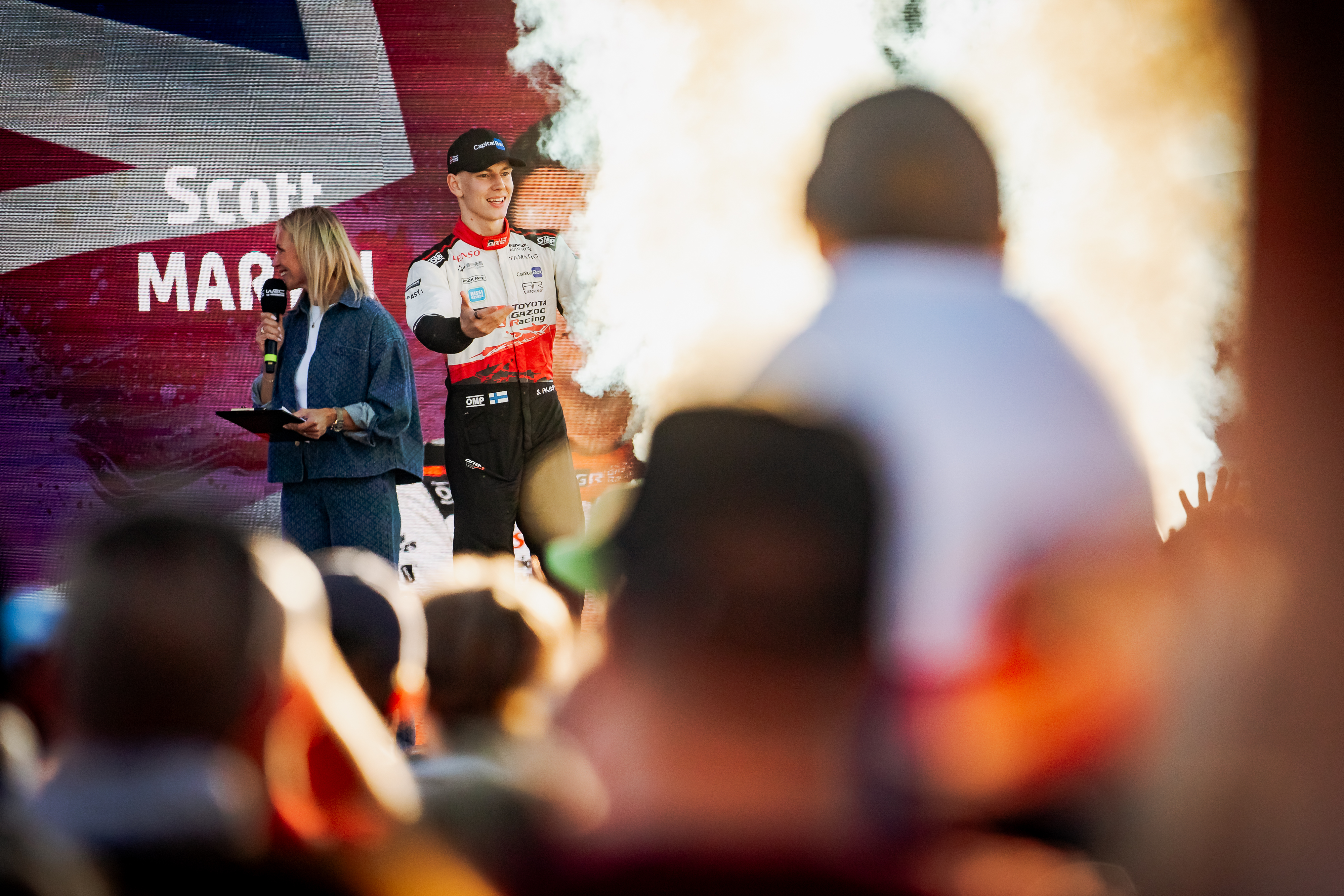
The tenth round of the FIA World Rally Championship gets underway on Thursday in its traditional home of Jyväskylä. This year’s Secto Rally Finland marks the first time that Sami Pajari and Marko Salminen arrive at their home event as winners of the previous WRC round.
The Toyota Gazoo Racing WRT2 crew currently sits third in the championship standings, meaning they will also be third on the road for Friday’s stages. Completing the trio of threes, this will also be Pajari’s third Rally Finland behind the wheel of a Rally1 car.
Expectations from the home crowd have undoubtedly grown following the Finns’ maiden WRC victory in Estonia. At the same time, the championship picture has become increasingly intriguing. With one major career milestone now achieved, attention can gradually begin to shift towards the title fight. After Rally Finland, only four rounds will remain in the season, making this an important point in the championship. Some drivers may choose to chase maximum points by taking greater risks, while others could adopt a more conservative approach with the bigger picture in mind. Those differing strategies may well influence the way crews tackle Rally Finland.
Twenty special stages covering 316 competitive kilometres on some of the fastest roads in the championship – roads that rarely forgive even the smallest mistake – leave plenty of room for tactical decisions. Sunday’s 30-kilometre Himos–Jämsä stage, run twice, will play a crucial role in both the Super Sunday and Power Stage points. A driver can score more championship points than the rally winner by combining a solid overall result with a particularly strong Sunday, and in the end, it is the championship points that matter most.
“To win Rally Estonia was amazing, and a feeling that is still sinking in. There was not much time to celebrate or relax, as two days after the rally we were already testing for Rally Finland.
Like Estonia, this is one of my favourite rallies, but it’s even more special to be able to compete at home in front of all my family and friends and a lot of fans cheering for us. The stages are beautiful and I really enjoy driving them. Many will be expecting that we can win again; we can’t underestimate the competition, but we of course hope that we can make it happen. I’m really looking forward to it.”
Looking at the forecast on Thursday of rally week, there is a possibility of showers and even thunderstorms around the Jyväskylä region on Friday afternoon and early evening. That could add another interesting element to the rally and influence whether the leading road positions prove to be an advantage or a disadvantage.
The rally begins on Thursday evening with the traditional Harju super special stage, run mostly on asphalt. There have been years when drivers have spent much of the following day trying to recover the time they lost on Harju, so the short 2.6-kilometre opener should not be underestimated.
Friday features nine special stages. The crews first tackle Laukaa and Saarikas, followed by the new Sydänmaa and Hoho stages. After service at the Jyväskylä Paviljonki, the same loop is repeated before the day concludes with another run through Harju.
Laukaa will be driven in the opposite direction compared to last year, with approximately six kilometres of new road added at the beginning. The opening section of Sydänmaa was previously used under the name Sirkkamäki in 2010, with Sébastien Ogier the only current Rally1 driver to have competed there. The final seven kilometres of Hoho were last used as part of the Halttula stage in 1995. That year Rally Finland was not a round of the top-level championship, and current Toyota team principal Juha Kankkunen struck a rock early in the event before spending the remainder of the rally driving as the zero car. Friday’s stages, located to the north-east and east of Jyväskylä, cover a total of 127.72 competitive kilometres.
Saturday heads south-west with Parkkola, Päijälä, Västilä and Leustu each run once before midday service at the Paviljonki, followed by a second pass through the same stages in the afternoon.
Parkkola has been extended slightly at the finish, although it cannot really be considered a new stage. Päijälä and Västilä will both be run in the opposite direction compared to last year. Päijälä is also much shorter than before, measuring just 10.55 kilometres – roughly half of its previous length – and was last run in this direction in the WRC in 2021. Västilä has not been driven in this direction at world championship level since the late 1990s. Saturday’s eight stages total 125.70 competitive kilometres.
Only two stages remain for Sunday. The 30.02-kilometre Himos–Jämsä stage will be run twice, making for a demanding final day despite covering “only” 60 competitive kilometres. The stage combines sections previously known as Vaheri, Patajoki and Himos, featuring a mixture of wide and narrow roads, high-speed sections and technical challenges. By the second pass, some sections are likely to become heavily rutted.
A regroup will take place at Himos between the two runs, while the rally-closing Power Stage is scheduled to begin at 13:15.