
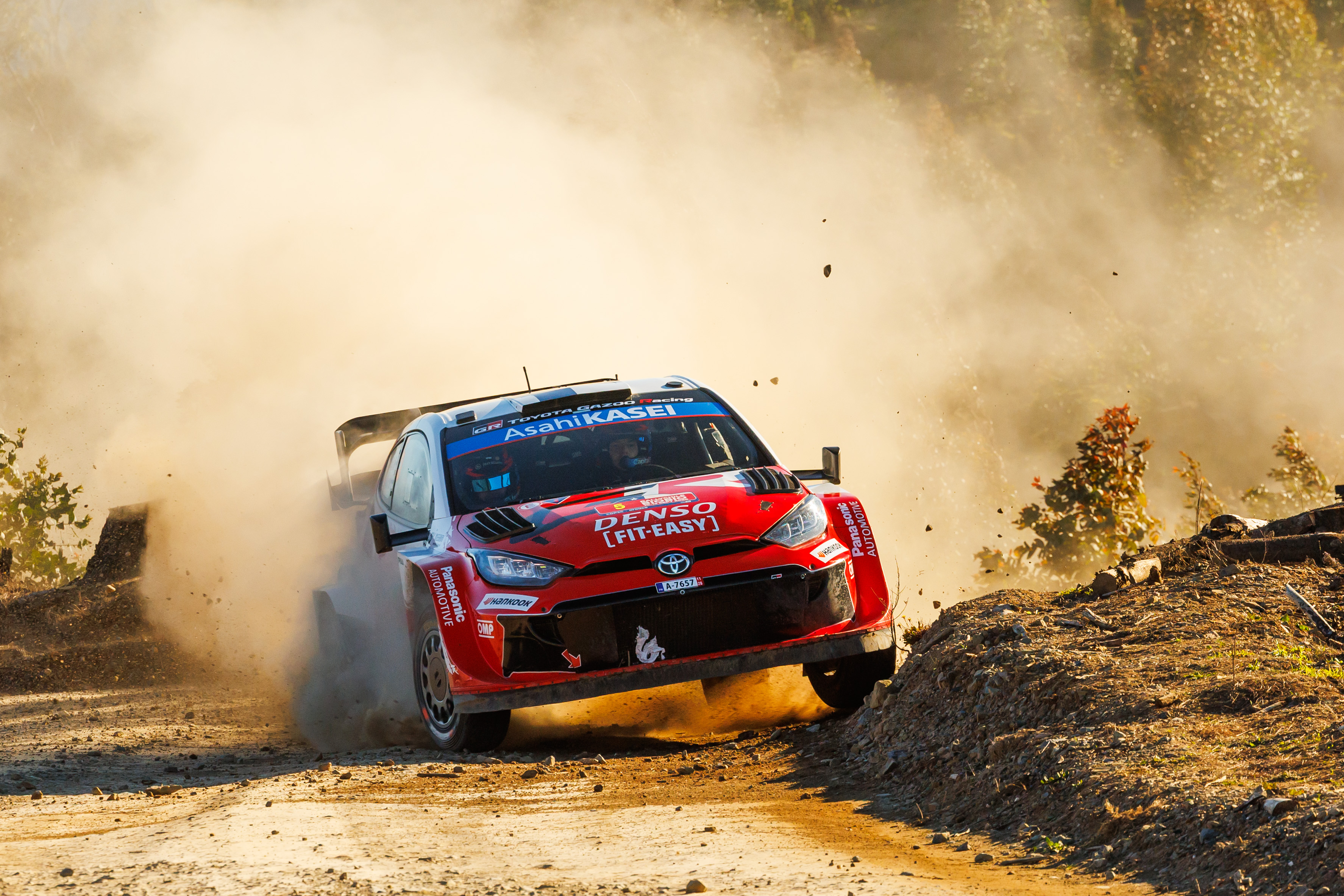
The 12th round of the FIA World Rally Championship, Rally Chile, did not bring the Toyota Gazoo Racing WRT2 crew of Sami Pajari and Marko Salminen the top result they had been hoping for. After three consecutive podium finishes, fourth place was perhaps not what the team had been aiming for, but after a rally full of twists and turns, the result still helped close the gap to championship leaders Elfyn Evans and Scott Martin.
Pajari was competing in Chile for the fourth time and was making his third appearance in the top class. Having previously said that he enjoys the rally and coming off a strong summer campaign, the Finnish crew started the weekend with cautious optimism.
Friday’s opening leg consisted of three stages in the central valley, each run twice either side of midday service. From the rally headquarters in Concepción, the route headed southeast. All three Friday stages were run in the opposite direction to previous years, with some sections that had not been used before. The day featured 100.78 kilometres of competition.
The opening stage, Turquía, immediately proved difficult. Conditions were extremely slippery and Pajari lacked sufficient confidence in his driving. He was only fifth fastest, losing 17.8 seconds to the stage winner over the 12.98-kilometre test.
“Very difficult. The grip is changing a lot and there were some narrow sections where you need confidence and rhythm,” Pajari commented after the stage.
Nuevo Rere, the next stage, went clearly better. Pajari was fourth fastest, losing just 2.8 seconds to the fastest time.
“We made some small changes. It felt better, so we just need to keep pushing,” the driver reflected after the stage.
The third stage of the loop, Hualqui, again felt more challenging and Pajari was only sixth fastest, 6.8 seconds off the pace.
“It was muddier than I expected. It felt okay, but we still need to improve because we lost time to Elfyn.”
The crew reached midday service in sixth place, 23 seconds off the lead, but only 5.3 seconds away from third.
The same three stages were then repeated in the afternoon, and Pajari immediately hit back with the fastest time on the opening test, moving up to fifth overall.
“Hopefully we can put together a good loop. There will be a lot of loose gravel tomorrow, so the road position is important. The conditions were very different from the morning; this was more like the traditional first-run conditions.”
The strong pace continued on the next stage. Pajari was only 0.1 seconds off the fastest time, despite a couple of moments along the way.
“They say we’re paying for the road, so we tried to really push and use the whole road. I think it was okay.”
The final stage of the day was another committed effort, with Pajari just 1.7 seconds off the fastest time. There were even a couple of smiles inside the car at one particular point.
“There were a couple of places we talked about in the recce and wondered whether they would take full commitment. We didn’t try it on the first pass, but this time it worked — just about,” Pajari laughed after the stage.
Pajari ended Friday in fifth place, 21.7 seconds off the lead and 3.7 seconds from third. Looking at the overall picture, almost the entire time deficit had been accumulated on the opening stage. The Finnish crew would start Saturday sixth on the road, roughly in the middle of the Rally1 field. Not ideal, but certainly not a bad position either.
Saturday was the longest day of the rally, featuring 139.2 competitive kilometres. The day consisted of two runs through three familiar stages south of Concepción. In previous years, Saturday’s stages had produced all kinds of conditions and incidents, and this time was no different.
The opening stage, Pelún, immediately set the tone. Pajari was fifth fastest, 8.7 seconds off the pace. Among his rivals, Thierry Neuville went heavily off the road and was forced to retire.
“Quite slippery and loose, so it’s going to be a tough loop for the tyres. We’re losing quite a lot to Ogier,” the Finn wondered.
Next came the long 25.64-kilometre Lota stage. Jon Armstrong crashed out, while Pajari was again fifth fastest, this time losing 13.2 seconds to the stage winner. The leading four cars were beginning to pull away, while the gap to the cars behind had grown to more than two minutes.
“One big moment where suddenly it was like driving on ice. I didn’t have the best confidence after that. A difficult stage.”
The final stage before service was the 28.31-kilometre María Las Cruces. Once again, Pajari was a consistent fifth fastest, but this time the gap to the fastest time was as much as 17.3 seconds.
“I should try to push, but I don’t quite have the right feeling with the grip and the car to do that,” Pajari explained.
After service, the crews headed back onto the same stages. Pelún went better on the second run, with Pajari again fifth fastest but only 4.8 seconds off the pace.
“The driving came together better rhythmically this time, but it could still be better. We’ll try to figure something out for tomorrow.”
Next came Lota again. The gap to the fastest time was smaller than in the morning, although not significantly, and Pajari was once again fifth fastest.
“Today has been a bit of a boring story from my side. Even when you try to push, the times just aren’t really coming. Of course, the road position plays a small part as well. Tomorrow we need to be better if we want to score more points,” Pajari said, reflecting on a day that had followed much the same pattern throughout.
The longest stage, María Las Cruces, was run for the second time to close Saturday, and the story was much the same again: Pajari was fifth fastest.
“There’s not much to say about today. No major drama, but the pace hasn’t been where we would have wanted it to be.”
On Sunday, the rally continued in the same coastal mountain region as Saturday. The new Carampangue stage opened the day, paired with the familiar Biobío test. Both were run twice, giving Sunday a total of 71.20 competitive kilometres.
On the 26.82-kilometre Carampangue stage, Pajari was once again fifth fastest, losing 11.1 seconds to the fastest time. The pace still seemed to be just out of reach.
“Unfortunately, there was a lot of loose gravel and there was no moisture left on the road surface.”
The following Biobío stage was shorter at 8.78 kilometres, but the relative time gap was larger. Pajari was again fifth fastest, 4.8 seconds off the pace.
The second run through Carampangue changed the complexion of the rally when second-placed Elfyn Evans suffered a puncture and had to change a tyre during the stage. The Finnish crew was fourth fastest, 15.3 seconds off the stage-winning time.
“Let’s see. Once again, anything can happen,” Pajari said ahead of the Power Stage.
On the final stage, Pajari finally delivered a very strong performance. He was third fastest, just 0.6 seconds off the fastest time.
“Two rallies left and there’s going to be a hard fight. It’s a shame we couldn’t quite perform at our best this weekend,” Pajari said after the stage.
The result was fourth place for Pajari and Salminen, while the gap to Evans in the championship standings was reduced to 17 points. Toyota also secured the manufacturers’ championship in Chile.
“This was a tricky rally for us. It wasn’t the result we would have wanted and the pace was not as good as we hoped for, but today we tried to maximise what we could and we were able to gain a few important points. In the end we didn’t lose anything because Elfyn was unfortunate today, and the championship fight is getting really interesting with Oliver doing a very good job here and scoring lots of points. Congratulations to everyone in the team for securing this manufacturers’ championship. Even if we have been scoring points for TGR-WRT2 instead, it’s nice to be part of this family and I’m super happy for everyone involved.”